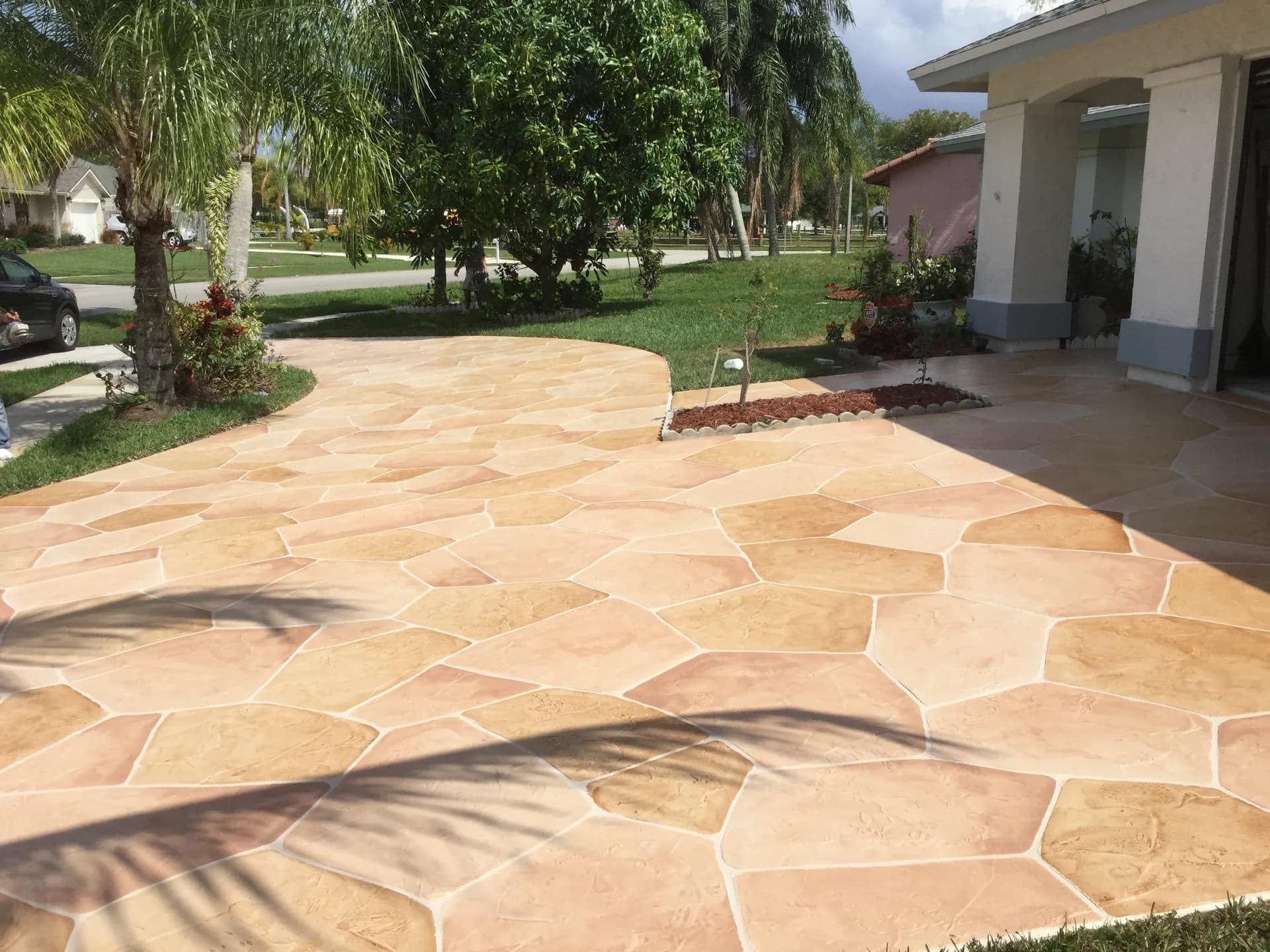
How Tree Roots Damage Concrete in South Florida
South Florida's year-round growing season means tree roots grow faster and more aggressively than in most states. The most damaging trees for concrete in Palm Beach County are ficus (extensive shallow root systems), live oak, royal poinciana, and queen palm. Root damage to concrete takes three distinct forms, each requiring a different repair approach:
- Surface cracking — Roots growing directly beneath the slab exert upward pressure as they thicken. The concrete cracks along the path of least resistance. If the slab hasn't heaved and the crack is hairline to ¼ inch wide, epoxy crack injection or overlay may be sufficient.
- Slab heaving — When roots grow under a section and lift it, the concrete rises unevenly. This creates both a visual problem and a trip hazard. Heaved sections cannot be leveled without removing the root cause — the raised slab must be cut out, the roots removed, the base recompacted, and new concrete poured.
- Voids from root decomposition — After tree removal, roots left in the ground decompose over 1–3 years, leaving irregular voids beneath the slab. The slab may look intact but be unsupported underneath — a hidden failure waiting to happen. Voids must be filled with flowable grout or polyurethane foam before resurfacing or pouring over the area.
Step 1: Stump Grinding Before Any Concrete Work
This is the most important step and the one most homeowners skip. If the tree stump and root ball are not fully ground out below the planned concrete surface before pouring, new growth from the remaining root system will re-damage the slab within 3–5 years. For concrete driveways or patios, the stump should be ground to at least 6–8 inches below finish grade — deeper than the concrete and base material combined. Confirm this with your tree service before they leave the site.
Assess the Damage: Repair vs. Replace
After stump removal, assess what the concrete actually needs. Not every root-damaged driveway needs full replacement:
- Repair candidates — Slabs with hairline to ¼-inch cracks that haven't heaved, where the surrounding concrete is still flat and structurally sound. Epoxy crack injection seals the crack and restores structural integrity. A decorative overlay can then cover the repair visually.
- Partial replacement candidates — Specific sections that heaved or cracked through the full thickness, where surrounding sections are in good condition. Cut out only the damaged section, remove the roots, compact the base, and pour a matching section.
- Full replacement candidates — Slabs where root damage is widespread across multiple sections, where multiple heaves created an uneven surface, or where the concrete is old (20+ years) and the tree damage has accelerated existing deterioration. Full replacement with proper root barrier installation is the right long-term choice.
Root Barriers: Preventing Future Damage
If you have other trees near concrete and are pouring new or replacement slabs, install a root barrier at the time of pour. A root barrier is a rigid or flexible sheet material installed vertically in the ground between the tree and the concrete — it redirects root growth downward rather than horizontally under the slab. Root barriers are installed during the concrete pour, not after. Cost is typically $5–$12 per linear foot including installation. For high-value driveways near ficus, live oak, or royal poinciana, this is insurance worth taking.
What Concrete Repairs After Tree Removal Cost in Palm Beach County
Cost depends heavily on the type and extent of damage:
- Epoxy crack injection: $5–$15 per linear foot — for non-heaved cracks
- Decorative overlay over repaired area: $8–$14 per sq ft — covers repaired cracks visually
- Partial slab replacement (one section): $800–$2,500 — includes demo, base prep, pour, and finish
- Full driveway replacement (with stump already removed): $6–$9 per sq ft for plain; $12–$18/sq ft for stamped
- Void filling with polyurethane foam: $10–$25 per sq ft of affected area
- Root barrier installation: $5–$12 per linear foot